Project Overview
The AI Cloud Drive is a document retrieval platform combining secure file storage with hybrid retrieval pipelines. Users upload technical documents to a personal drive and query them using context-grounded retrieval and cross-encoder reranking.
Core Capabilities
- Secure Storage: Personal cloud drive with file management (upload, share, delete).
- Semantic Search: Semantic search across all uploaded documents.
- RAG Chatbot: Context-aware Q&A using Groq's Llama models.
- Enterprise-Ready Auth: Google OAuth, Magic Links, and RBAC features.
- Observability: Prometheus monitoring and comprehensive audit logging.
Visual Tour
User Registration & Authentication
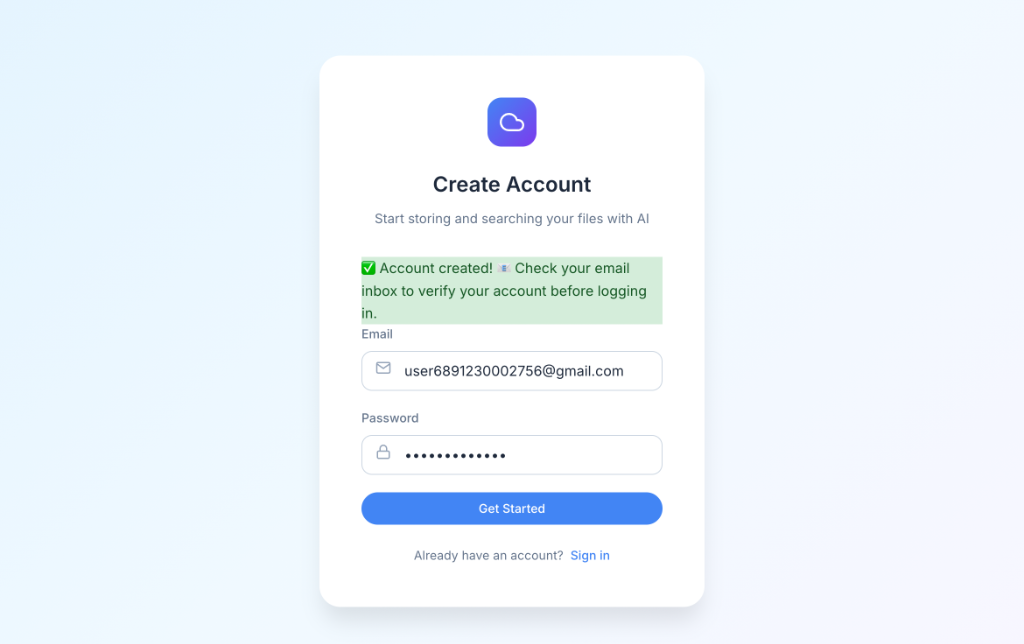
Features: Email verification with tokenized links, password strength validation, resend verification functionality.
Main Dashboard (File Manager)
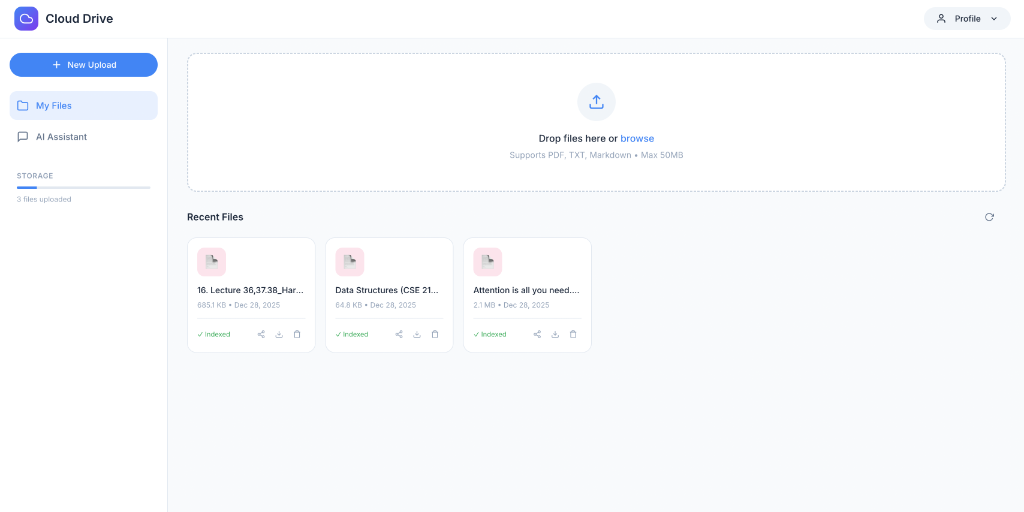
Capabilities: Drag-and-drop upload, real-time status polling (Processing → Indexed), file metadata display.
RAG Chat Interface
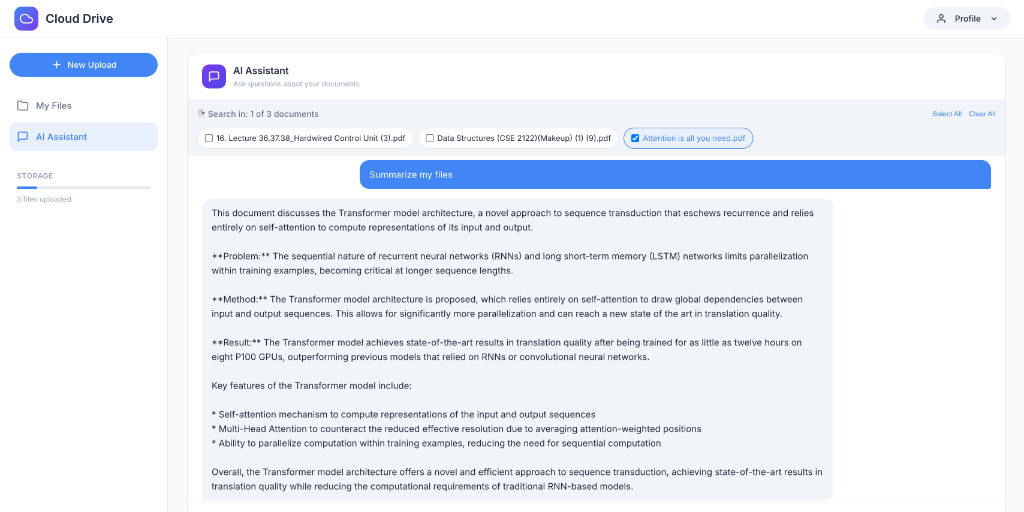
Features: Multi-document filtering, inline citations with [Source 1] references, context preview cards.
Query Auditor & Guardrail Validation
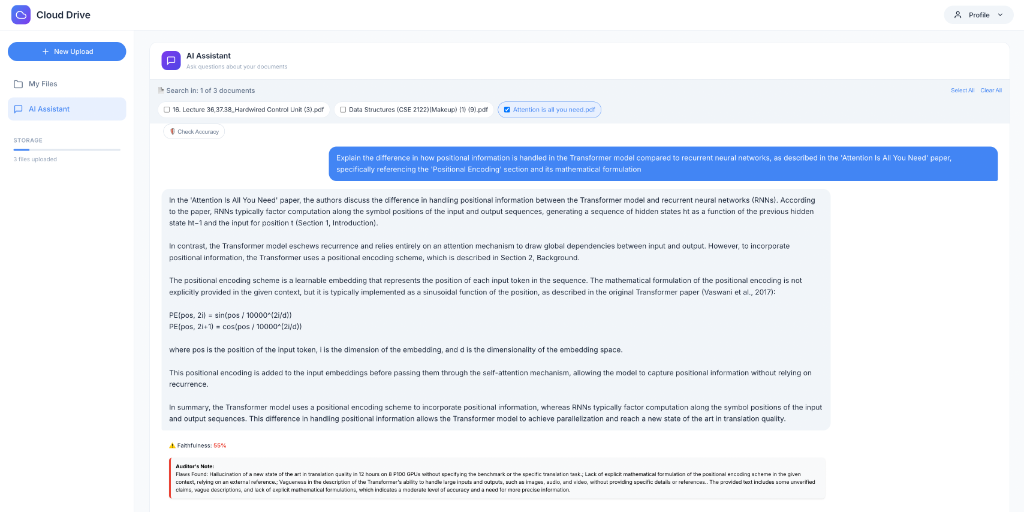
The system validates context grounding by preventing generation when retrieved context is insufficient, logging query telemetry for auditing.
Admin Dashboard
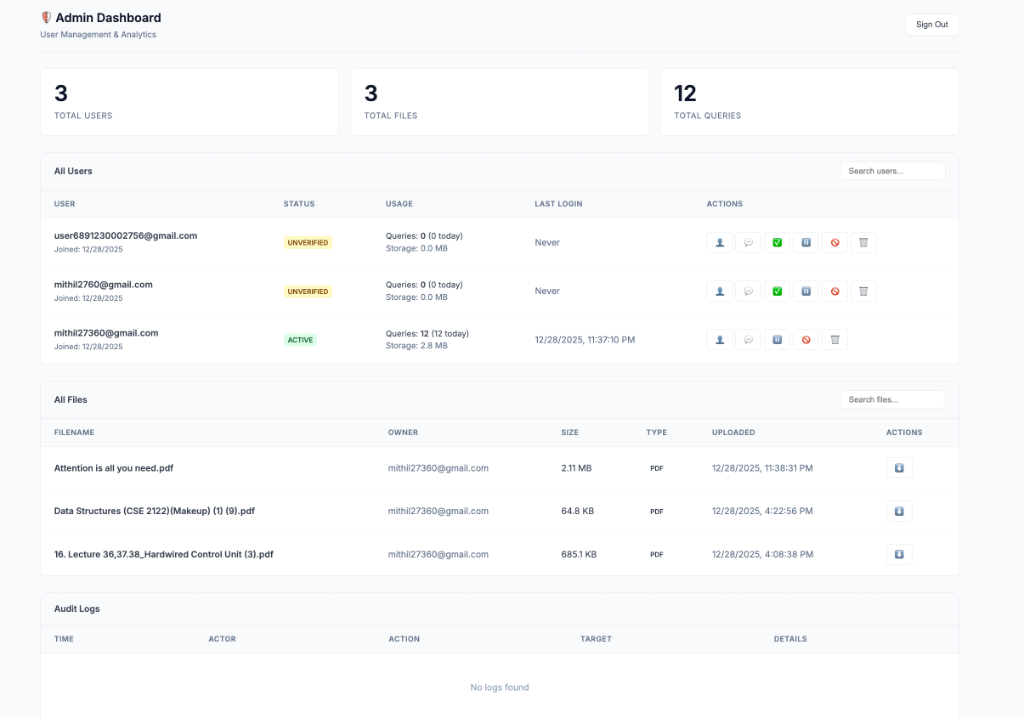
Admin Capabilities: User management, storage analytics, real-time audit logs, system health monitoring, chat history auditing.
System Architecture
|
+--> API [FastAPI]
|
+--> Auth [Google OAuth]
+--> LLM Ops [Groq API]
+--> Task Queue [Redis]
|
+--> Worker [Celery] --> OCR/Index
|
+--> Data Layer
|--> PostgreSQL (Metadata)
|--> MinIO (Object Storage)
|--> ChromaDB (Vectors)
Component Details
3.1 Frontend (/frontend)
- Tech Stack: Vanilla HTML5, CSS3, JavaScript (ES6+), served via Nginx.
- Key Modules:
app.js(Main logic),admin.js(Dashboard),auth-container(Dynamic auth flows). - Features: Drag-and-drop uploads, real-time chat with typing indicators, file sharing dashboard.
3.2 Backend (/backend)
- Framework: FastAPI (Python).
- key Routes:
auth.py(JWT/Login),files.py(CRUD),query.py(RAG search).
3.3 RAG Architecture
The RAG engine is modular and designed for high precision:
- Ingestion: Upload -> MinIO -> Celery Task -> OCR (Tesseract) -> Chunking -> Embedding (Sentence Transformers) -> ChromaDB. Processed and indexed 1,000+ document chunks with hybrid retrieval and reranking pipelines.
- Retrieval Strategy: Vector Search (ChromaDB) + Cross-Encoder Re-ranking to re-score candidates for semantic relevance, optimizing retrieval quality, citation tracking, and context validation to improve retrieval reliability and context grounding.
- Generation: Top results assembled into context -> Groq API (Llama 3 70B) for response.
Key Design Decisions
- Hybrid Search/Re-ranking: Instead of relying solely on vector similarity, the system retrieves a larger set of candidates and uses a Cross-Encoder to re-rank them, significantly improving accuracy.
- Async Processing: Computational heavy lifting (PDF parsing, embedding) is offloaded to Celery workers to keep the API responsive.
- Privacy-First RAG: ChromaDB queries are strictly filtered by
user_id, ensuring users can never search across another user's private documents. - Modular Auth: Supports passwordless (Magic Link), OAuth (Google), and standard flows simultaneously.
Security Features
- JWT Authentication: Stateless, secure session management.
- RBAC: Role-Based Access Control (Admin vs. Standard user).
- Audit Logging: All sensitive actions (deletions, sharing) are recorded.
- Secure File Serving: Files served via signed URLs or authenticated proxy endpoints.